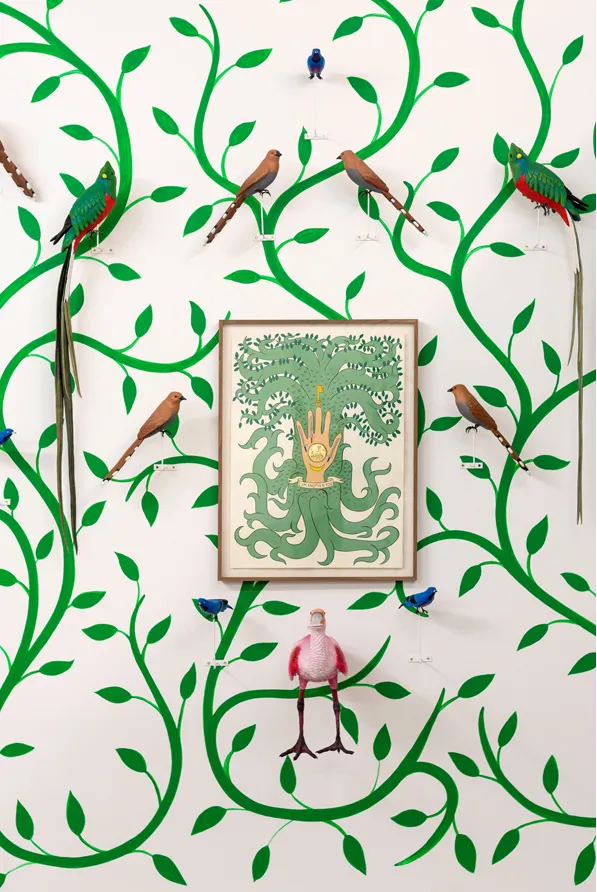
Los Angeles-born, Mexico-based Eduardo Sarabia has becomeone of the better-known artistic voices of his generation for using materialsand imagery associated with street culture, craft, and folk history to drawconnections between his personal story and the narrative of Mexico, the land ofhis chosen home and ancestral heritage. Often using spray paint, ceramic, andtextiles and colorful flora, fauna, and symbols, he creates bold artworks thatprompt questions about definitions of taste and the consequences of economicforces, especially on long-held traditions and the natural world.
Ceiba Sagrada presents, for the first time,artworks by Eduardo Sarabia recently acquired by the Museum in an installationdesigned and realized by the artist. In a gallery overlooking the Gardens,Sarabia paints a mural of sprawling green vines as a lush backdrop for anacrylic and ink drawing of a sacred ceiba tree and a flock of fourteencolorful, sculptural birds. Though the birds are all endangered species, herethe ceramic versions are thriving amongst the robust trunk and limbs of a treerevered in tropical parts of the Americas for straddling between theunderworld, humans, and the heavens.
Sarabia has drawn within the ceiba’s trunk severalmysterious symbols: an open palm, swords, a moon, and a gold coin stamped witha deer and the numbers 1976 (the year of the artist’s birth). Above all of thisa golden key, and below a scroll featuring the credo I AM ANOTHER YOU. Thoughelusive, the symbols seem to honor the power of knowledge, whether passed downthrough ancestry—the artist’s grandfather shared a story of buried treasure—orculture—quetzal birds were understood to be so powerful in Mesoamerica that itsfeathers adorned headdresses, including that of Moctezuma, who ruled at thetime of Spanish conquest.
Taken together, the elements in Eduardo Sarabia’sinstallation Ceiba Sagrada seem to suggest that the key to aprosperous and sustainable future is safeguarding not only flora and fauna, butalso the ancient traditions that remain all around us.


