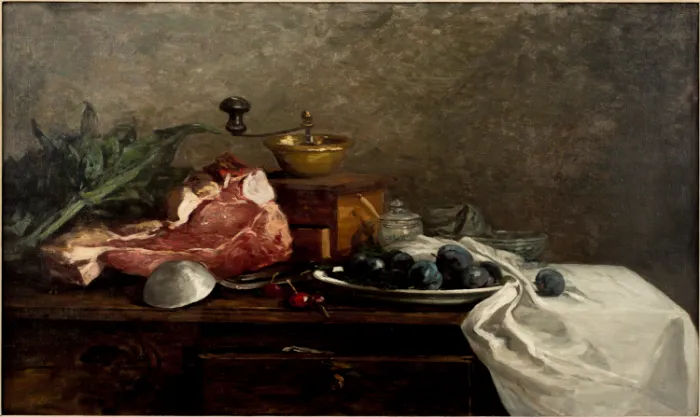
Images of flowers, food, and other inanimate objects, calledstill lifes, have been popular across cultures and far back into prehistory,including in ancient Egypt and Rome. In the 1600s, still life painting becamepopular in Holland, where the objects pictured often carried an allegoricalmeaning. Soon after in France, still life became codified as an officialpainting type, or genre, within the French Academy’s rigid hierarchical systemof valuing paintings. They put still life at the bottom of their hierarchy.Despite its lowly status, the constraints of still life created an opportunityfor artists to experiment with composition, form, color, and style, and itremains a popular format today.
This exhibition presents a capsule collection highlighting adiverse range of artistic styles from the past 300 years through the genre ofstill life. From 18th century ornithological paintings by Samuel Dixon toEugène Boudin’s moody and painterly composition of the 19th century, toexamples by modernist artists like Rebecca Salsbury James, Georgia O’Keeffe,and Pablo Picasso, the exhibition walks visitors through many of the majorartistic movements into the 20th century. One section highlights photographicstill life, with work by Russell Lee, Lusha Nelson, and Brett Weston. A finalgrouping includes contemporary works—particularly photorealist work—by CarolynBrady, Audrey Flack, and Tony Matelli.
Eugène Boudin (French, 1824–1898). Still Life with Coffee Mill, c. 1856. Oil on canvas, 17 3/4 × 29 1/2". Philbrook Museum of Art, Tulsa, Oklahoma. Gift of Mr. and Mrs. Herbert Gussman, 1963.13.


