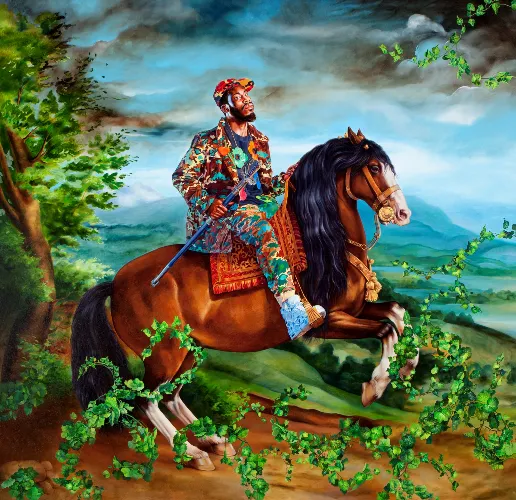
Give your students 30 to 60 seconds to look at this work and take in all the details.
Artist Kehinde Wiley asks: “What is portraiture? It’s choice. It’s the ability to position your body in the world to celebrate you on your own terms.”
This artwork features a contemporary portrait of an African American man and explores the themes of race, representation, and agency.
Traditionally, large-scale portraits—paintings that represent specific human subjects—would have depicted wealthy, powerful, and often white patrons like Philip IV, King of Spain and Portugal. This painting reimagines Diego Velázquez’s 1635 portrait of Philip IV, which you can view
here. In this rendition, an unidentified Black man replaces King Philip, an inversion of long-standing power structures regarding race and class, yet artist Kehinde Wiley retains the original painting’s title and leaves his model unnamed. By intentionally placing Black subjects in positions of power, Wiley prompts viewers to consider the lack of such images on many museum walls.In addition to Wiley’s recasting of King Philip, other distinctions are worthy of note. The tension between the rearing horse and static rider appears in both Velázquez’s and Wiley’s paintings. However, while Philip IV has a thousand-yard stare, Wiley’s unnamed sitter meets the viewer’s gaze. This noticeable shift in the subject’s gaze encourages viewers to consider the sitter’s active participation in the creative process and demands recognition of his dignity and individuality. Indeed, the model here has chosen to present himself in a dynamic hip hop ensemble, wearing a brightly colored, camouflaged suit set paired with a matching cap and designer high top sneakers.
Twisting vines of kudzu, an invasive weed endemic to the southern United States, splash across the bottom of Wiley's canvas. As dust storms plagued the country in the early twentieth century, the government promoted kudzu as a way to combat widespread soil erosion. This decline in soil quality resulted from the exhaustive cotton production characteristic of the south's plantation slavery system. Here, the vines may serve as a metaphor for the pervasive and persistent qualities of racism and the rippling effects of American slavery.