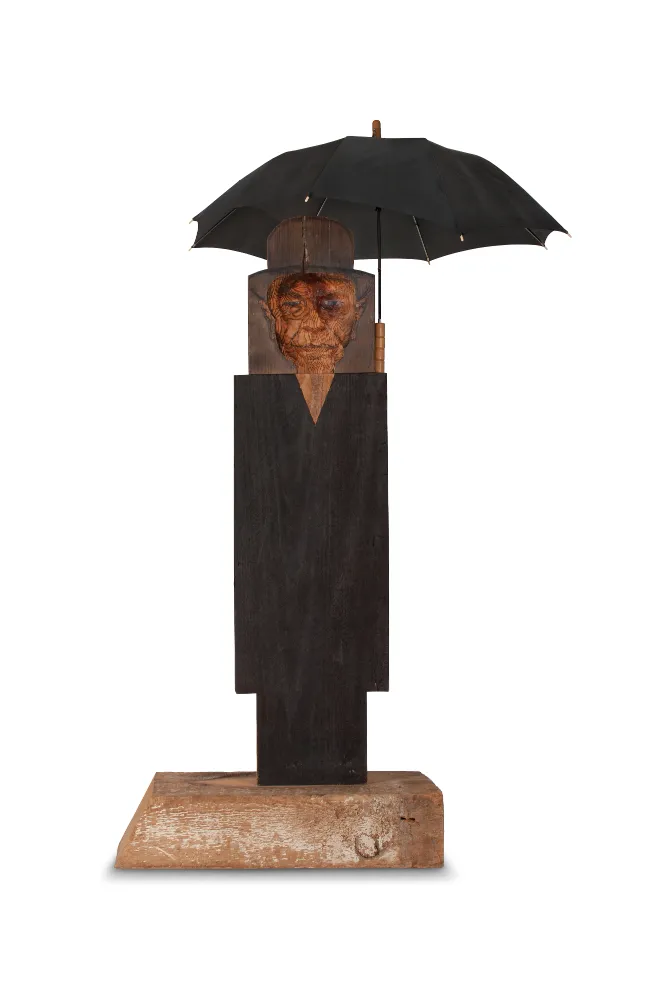
Take some time to look closely at this work of art.
Art isn’t always what it seems at first glance.
Consider the mood of the figure.
It’s best to view three-dimensional objects from as many angles as possible. Take a look at the back of this artwork.
Marisol may have created this sculpture to, in part, illustrate the connection she felt with Magritte.
In this sculpture, Marisol positions artist René Magritte as the subject of her own work of art, exploring their personal and professional connections.
In 1998, Marisol completed a series of six wooden sculptures of René Magritte (1898-1967), a Belgian artist whose work toys with truth and illusion by featuring common objects in unusual contexts. (
You can view some of Magritte’s work here.) Marisol’s sculpture—or homage, as she called them—shows an older Magritte wearing a bowler hat and holding a real, open umbrella, two symbols that appear throughout Magritte’s work.
Her Magritte series, like other works by Marisol, mixes realism with abstraction. Some elements are shown in great detail while others remain blocky and geometric. For example, the carved face strikes viewers as the most intricate part of the sculpture. Marisol manipulates the rich wood grain to convincingly contour Magritte’s features and completes his eyes and eyebrows with charcoal. This face, however, juts out from a thick torso made from discarded wood embellished only with a wash of black.
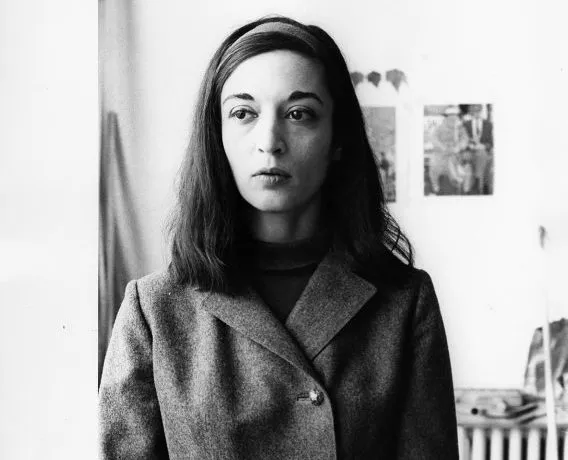
On the back of the sculpture's head, Marisol includes a line drawing of her own face. Throughout her career, she repeatedly represented herself in her artwork. She stated: “There comes a point when you start asking, ‘Who am I?’ I was trying to find out through my sculpture.” This self-portrait may also allude to the connection Marisol felt with Magritte, both professionally and personally. Both artists experimented with space and reality in their work. Both artists also lost their mothers at an early age. After Marisol lost her mother, she took a vow of silence, refusing to speak voluntarily until she was in her twenties. She later memorialized her mother in Mi Mama y Yo (My Mom and I) (1968), which you can view
here.